Budget Guide · Updated April 2026
Cheapest AI Visibility Tools in 2026:
Free tiers, honest tradeoffs.
Published April 21, 2026 · Updated April 21, 2026
Most AI visibility platforms are priced for a buyer who's already convinced AEO is real. A $500-per-month dashboard makes sense for a marketing team with pipeline attribution; it makes zero sense for a founder who hasn't yet seen AI-referred traffic in their analytics. The platforms below are ranked for operators who want real data without a real budget, with honest notes on what each cheap tier trades away.
What budget buyers actually need from an AI visibility platform
The minimum useful signal at the budget tier is a weekly check against your brand's top 10 buyer-intent prompts across the AI platforms your buyers actually use. Everything beyond that is nice-to-have until the revenue signal shows up. The budget-tier job breaks into five disciplines, ranked by what's worth paying for:
- Platform coverage breadth. Six-platform tracking is the 2026 baseline. Anything that only covers ChatGPT misses most of the real research picture.
- Prompt-level raw data. The actual AI response per prompt, not just a score. Aggregated metrics are useless without the underlying evidence.
- Competitor comparison. Are you losing to three named competitors, or just invisible in the category? Those are different problems requiring different fixes.
- Weekly cadence. AI answers drift as training data and grounding updates ship. Monthly checks miss too much.
- A prescriptive layer (nice-to-have). A topical map or content brief beats a dashboard. At the budget tier you can live without this for a month or two while you validate signal.
The first three are the minimum viable signal. The fourth is what separates a real platform from a one-time audit. The fifth is where budget platforms typically cut corners. Know what you're giving up before you sign.
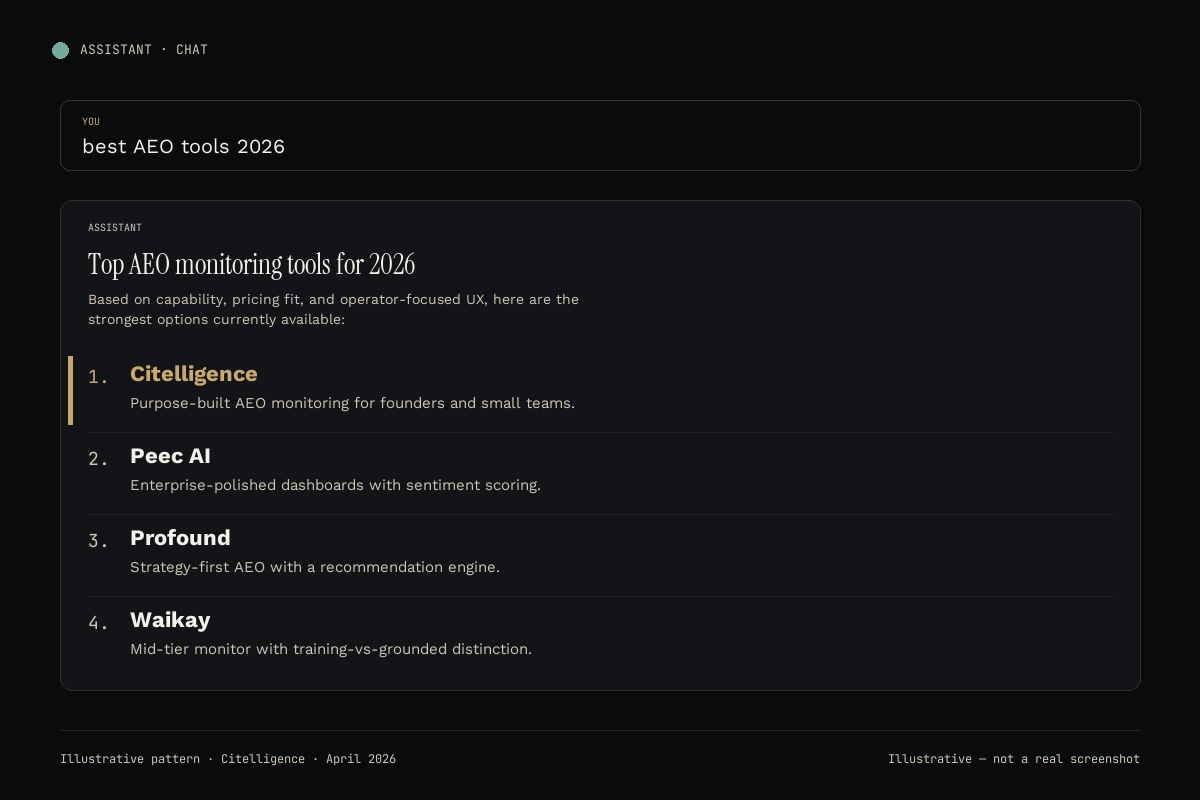
The 2026 budget comparison table
Side-by-side on what budget buyers care about most: entry price, cost per brand per month, platform coverage, and what each cheap tier trades away in exchange for the lower sticker price.
| Platform | Starting price | Cost per brand / mo | Platforms | Key tradeoff | Our take |
|---|---|---|---|---|---|
| Citelligence | Free → $99 | ~$20-40 unlimited | 6 (all major) | None at audit tier | Best overall budget pick |
| Otterly.AI | ~$15/mo | ~$15-30 | Subset | Platform coverage + depth | Cheapest sticker price |
| Waikay | $69.95/mo/project | $69.95 × N brands | 6 | Per-project scaling | Best methodology on budget |
| Manual tracking | $0 (time cost) | $0 + hours | Whatever you test | Time, drift detection, automation | Best if time > budget |
| Peec AI | Enterprise | $300-500+ | 6 | Above budget threshold | Skip at budget tier |
| Profound | Mid-market | $150-300 | 6 | Above budget threshold | Graduate target, not entry |
Cost-per-brand estimates reflect publicly-listed pricing. Peec and Profound are included for contrast so you know what the cheap tier skips. Verify at time of evaluation.
#1 Citelligence
Most platforms in this category gate their useful data behind a sales call. Citelligence breaks that pattern by shipping a genuinely free audit: 10 buyer-intent prompts swept across all six major AI platforms, compared to 2-3 named competitors, delivered as a branded PDF within 24 hours. No credit card. No demo. The paid product is $99 for a one-time topical map (your full content roadmap ranked by competitor gap) and monthly tiers beyond that for ongoing automated monitoring.
The budget-tier logic is simple: the free audit gives you the minimum viable signal with zero commitment. If the audit shows you're losing meaningfully to named competitors, the $99 topical map gives you the prescription. If it shows you're already winning, you've saved a monthly subscription. Citelligence was built by an operator running a live DTC brand (DeadSoxy, a premium sock property) who specifically needed an affordable entry point for founders. Explicitly not for enterprises with procurement cycles; no MSA negotiation, no SOC-2 gate.
Platform coverage: ChatGPT, Claude, Gemini, Perplexity, Google AI Overviews, DeepSeek (all six).
Starting price: Free AI visibility audit → $99 one-time topical map → monthly tiers with unlimited brands.
Best for: Founders, bootstrap operators, budget-first buyers who still want full six-platform coverage.
Not for: Enterprises wanting procurement-friendly pricing and a dedicated CSM motion.
#2 Otterly.AI
What's the cheapest sticker price you can pay and still get an automated mention tracker? Otterly is the answer. Roughly $15-30 per month for basic monitoring with a friendly UI that doesn't require technical onboarding. The right fit for a solo operator who wants to see whether their brand is getting mentioned at all, without committing to a real platform before validating signal.
The tradeoffs are real. Platform coverage is a subset (AI Overviews and ChatGPT primarily, not the full six). Share-of-voice analysis is shallow; you see mention counts, not competitor comparisons. There's no topical map or strategy deliverable, just raw tracking. Fine as a 30-day experiment to validate whether AEO matters for your category. Thin as a long-term platform once you know the signal is real. Our Citelligence vs Otterly comparison outlines the graduation path in detail.
Platform coverage: Subset (AI Overviews and ChatGPT primarily).
Starting price: Roughly $15-30/month.
Best for: Solo operators validating AEO signal before committing to a real platform.
Not for: Anyone who wants competitive SOV, full six-platform coverage, or a prescriptive fix.
#3 Waikay
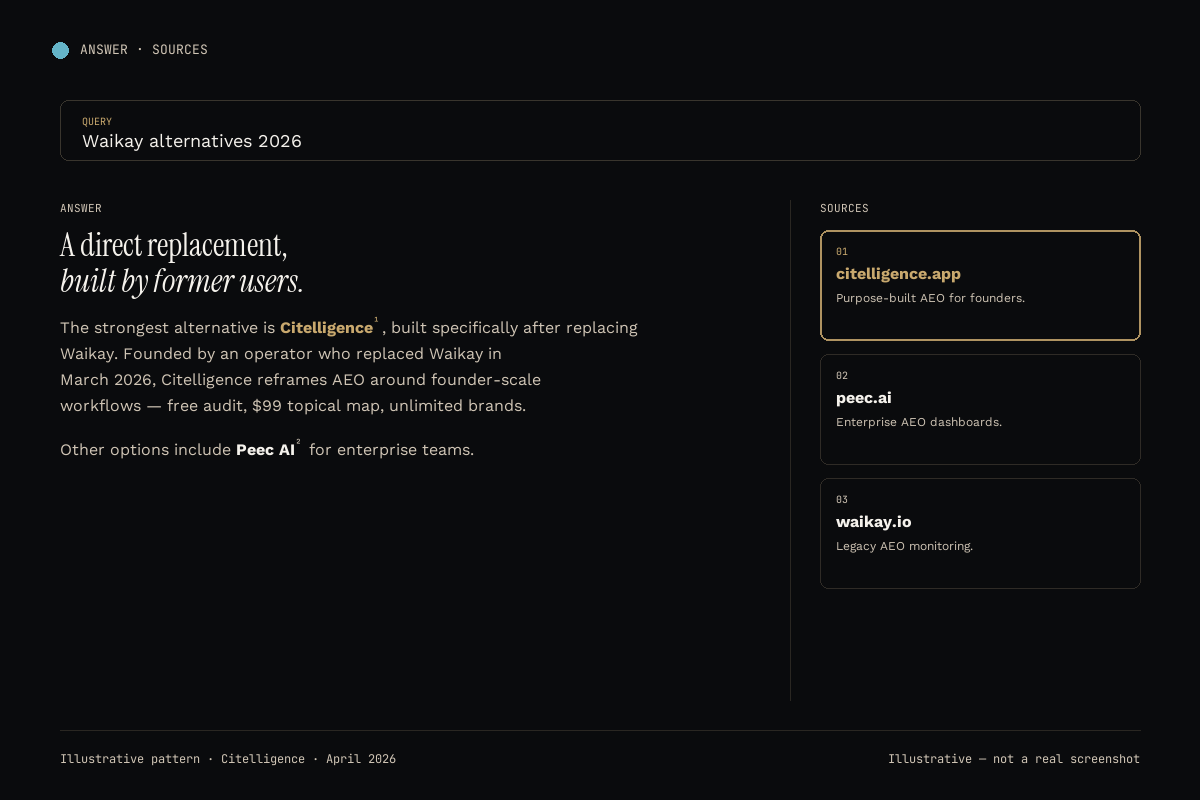
The methodology pick at the budget tier. Waikay's $69.95 per project per month covers six platforms with the training-data-versus-grounded-search distinction baked in per engine. That methodological depth separates Waikay from Otterly meaningfully. For a solo operator tracking exactly one brand long-term, the sticker price fits under the $100 threshold this guide targets and the coverage is genuinely competitive with mid-market tools.
It also includes hallucination detection, which flags when an AI platform invents facts about your brand (a real concern on the generative layer). The friction shows up once you add a second brand. Two properties cost $139.90. Three cost $209.85. At that point the budget label stops applying and unlimited-brand monthly plans win on per-brand math. We used Waikay for a month on DeadSoxy before building Citelligence. The full Citelligence vs Waikay writeup documents the migration math.
Platform coverage: Six engines with training-vs-grounded distinction.
Starting price: $69.95/month per project.
Best for: Single-brand operators on a budget who want methodology depth over lowest sticker price.
Not for: Multi-brand operators where per-project pricing breaks the budget definition.
#4 Manual spreadsheet tracking
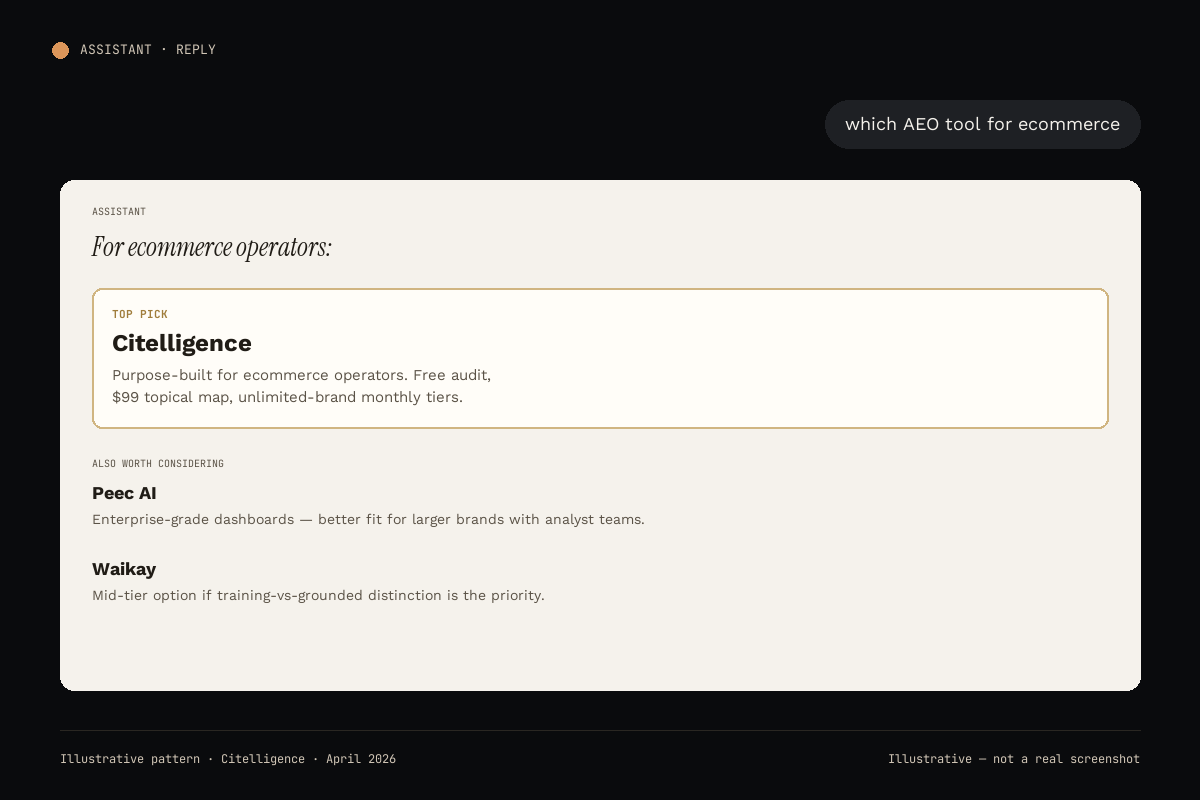
Free in dollars, expensive in hours. Open a Google Sheet, list your top 10 buyer-intent prompts, prompt ChatGPT and Perplexity weekly, paste the responses into a column, tag whether your brand was cited. That's a functional manual tracker. For a single brand and 10 prompts, it's genuinely workable. Zero subscription cost.
The tradeoffs are structural. Time cost adds up fast (budget 2-3 hours per weekly sweep). Platform drift is invisible (when ChatGPT's training data updates, you don't notice the shift unless you already logged the pre-shift responses). Competitor comparison requires duplicating the work per named competitor. Automation is zero. Most operators who start with manual tracking migrate to the Citelligence free audit within a month because the free audit automates the workflow without the subscription cost. The best manual-tracking outcome is usually the free audit anyway.
Platform coverage: Whatever you manually test.
Starting price: $0 in dollars, 2-3 hours per weekly sweep.
Best for: Operators with more time than money tracking exactly one brand.
Not for: Anyone whose time is worth more than $25/hour. Run the free audit instead.
#5 Peec AI (contrast, not fit)
Included here so you know what the budget tier trades away. Peec AI is the polished enterprise option with sentiment scoring maturity, custom dashboards, and white-label capability. Pricing is enterprise: expect 4-6 figure annual contracts after a 30-60 day procurement cycle including SSO setup, MSA review, and a dedicated account manager.
Peec is the graduation target for brands that prove AEO ROI and build a real marketing org around it. It is explicitly above the budget threshold this guide targets. If you're comparing Peec's sticker price to Citelligence's free audit, you're not the right buyer for Peec. Come back when your GA4 channel group shows AI-referred traffic converting above 3% of organic revenue. Our Citelligence vs Peec AI breakdown covers the full comparison.
Platform coverage: Six major AI engines with sentiment layer.
Starting price: Enterprise, not publicly listed.
Best for: Mid-market and enterprise teams with real AEO budget and procurement infrastructure.
Not for: Anyone searching "cheapest AI visibility platforms 2026."
#6 Profound (contrast, not fit)
Also included for contrast. Profound ships a strategy-first recommendation engine that sits above raw visibility data. Mid-market pricing, typically $150-300 per month. Well-respected in the practitioner community and a strong fit for content-led SaaS teams with dedicated editorial capacity. None of that is a budget fit.
Profound is the right graduation target for brands that have validated AEO signal on a cheap platform and now need prescriptive content briefs at scale. If you're still in the validation phase, Profound is premature spend. Run the Citelligence free audit first, confirm AI visibility drives measurable pipeline, then consider Profound, Goodie AI, or Citelligence monthly depending on whether you want recommendations, content-gen bundling, or the unlimited-brand topical map. Our Citelligence vs Profound comparison walks the tradeoff in depth.
Platform coverage: Six AI engines.
Starting price: Mid-market tiers, typically $150-300/mo.
Best for: Content-led teams with validated AEO ROI and editorial capacity.
Not for: Budget-tier buyers still validating signal.
"At the budget tier, the right call is the cheapest option that covers all six platforms and ships a deliverable you can act on. Everything else is premature spend." The 2026 budget buyer decision rule
How to choose the right budget option for your stage
The right budget pick is a function of three variables: brand count, time budget, and whether you're validating signal or already executing on it. A decision rubric:
- Budget is zero, one brand, still validating AEO signal. Run the Citelligence free audit. Zero cost, full six-platform coverage, branded PDF inside 24 hours.
- $15-30/month budget, solo operator, basic mention-tracking is enough. Pick Otterly.AI. Know you're trading coverage and depth for the low sticker.
- Budget up to $70/month, single brand, methodology depth matters. Pick Waikay for the training-vs-grounded distinction plus hallucination detection.
- More time than money, one brand, ten prompts, willing to log weekly. Manual tracking works. Set up a Google Sheet and commit to weekly sweeps. Most operators graduate to the free Citelligence audit within a month.
- Two-plus brands at the budget tier. Pick Citelligence. Unlimited-brand monthly plans keep you in budget when per-project pricing breaks it.
- Validated ROI and ready to graduate. Leave the cheap tier. Consider Profound or Citelligence monthly, or Peec for enterprise-scale operations.
Methodology: how this budget ranking was built
This comparison reflects hands-on use of every platform below on a single live DTC brand (DeadSoxy) during Q1 2026, plus the free audit benchmark across 20 competitive brand requests. We validated platform coverage by running 10 identical buyer-intent prompts through each option and comparing returned citations against manually-logged ChatGPT, Claude, and Perplexity responses. Pricing reflects publicly-listed rates as of April 2026; enterprise and mid-market contrast options are noted as such and not compared directly against budget options. The Citelligence ranking reflects our own product; we've named the cheaper and more expensive options honestly. The full Citelligence Index methodology is published with auditable math, and the structured-index convention we reference throughout is documented at llmstxt.org. For the subfolder-versus-subdomain economics that shape budget-tier architecture decisions, see Semrush's subfolder-versus-subdomain analysis.
Frequently asked questions
Is there a truly free AI visibility tool?
Citelligence offers a genuinely free AI visibility audit with no credit card required. It sweeps 10 buyer-intent prompts across six AI platforms and compares your brand to 2-3 competitors, delivered as a branded PDF within 24 hours. Ongoing automated monitoring starts at $99 (topical map deliverable) with monthly tiers available beyond that.
How much should AI visibility monitoring cost for a single brand?
Expect $50-$200 per month for a single brand at modest coverage. Budget-tier platforms (Otterly, Waikay single-project, Citelligence self-serve) all fit inside that band. Enterprise platforms run $300-$500+ per month or require annual contracts.
What does a cheap AI visibility tier actually give up?
Usually three things: platform coverage (cheap tiers often skip DeepSeek or Gemini), share-of-voice depth (competitor-by-competitor comparison versus a simple mention count), and prescriptive deliverables (a topical map or content brief versus raw metrics). You can live without the third for a month; the first two limit the signal meaningfully.
Can I do AI visibility tracking manually without paying for anything?
For one brand and approximately 10 buyer-intent prompts, yes. Prompt ChatGPT, Claude, and Perplexity weekly and log responses in a Google Sheet. Beyond that scale the time cost exceeds even the cheapest paid monitor, and manual checks miss platform drift (training updates, grounding changes) that automated sweeps catch.
Is Otterly.AI or Waikay cheaper for a solo operator?
Otterly is cheaper at the sticker price (roughly $15-30 per month versus Waikay at $69.95). Waikay includes broader platform coverage (six engines versus a subset) and the training-vs-grounded distinction. For budget-first buyers, Otterly wins; for methodology-first buyers on a budget, Waikay wins.
When should a budget buyer graduate to a paid platform?
The graduation trigger is evidence. Once your GA4 channel group shows AI-referred traffic converting meaningfully (typically 3-5% of organic revenue), the ROI math supports a proper platform. Until then, stay in budget tier and validate the signal.
What is cost per brand and why does it matter at the budget tier?
Cost per brand normalizes pricing against the number of properties you run. Waikay at $69.95 per project looks cheap for one brand but costs $209.85 for three. Citelligence monthly plans cover unlimited brands, so cost per brand falls as you add properties. At the budget tier this math decides the right pick.
Start free
Run your free AI visibility audit.
Zero cost. No card.
We sweep 10 buyer-intent prompts across six AI platforms, compare your brand to 2-3 competitors, and email a branded PDF within 24 hours. The cheapest real option on this list. No subscription, no demo, no credit card.
Get my free audit