AEO Comparison · Updated April 21, 2026
Citelligence vs Profound
Two scores. Never averaged.
Published April 21, 2026 · Updated April 21, 2026
Profound is the most respected strategy-layer product in the AEO category. Citelligence is the raw-data-plus-topical-map product. Both are legitimate. The honest question for a buyer is whether the team wants a recommendation engine to interpret data for them or the raw signal with a structural gap analysis. Three questions resolve this in under a minute and the rest of this page is the supporting detail.
What each tool actually does in 2026
Citelligence sweeps buyer-intent prompts across six AI platforms weekly, scores share of voice against named competitors, exposes every raw per-prompt AI response, and delivers a topical map: the specific hub-cluster-pillar pages you need to write to close your visibility gap.
Profound runs a similar sweep across the same six platforms, layers a recommendation engine on top of the raw signal, and generates content briefs tied to specific gaps in your answer-engine coverage. The workflow assumes a content team reads the brief and ships.
- Shared ground. Six-platform coverage. Weekly sweeps. Competitor benchmarking. Gap detection.
- The split. Profound recommends. Citelligence exposes.
- Who it fits. Profound assumes a content team. Citelligence assumes a single operator or a founder.
Pricing: the procurement vs self-serve split
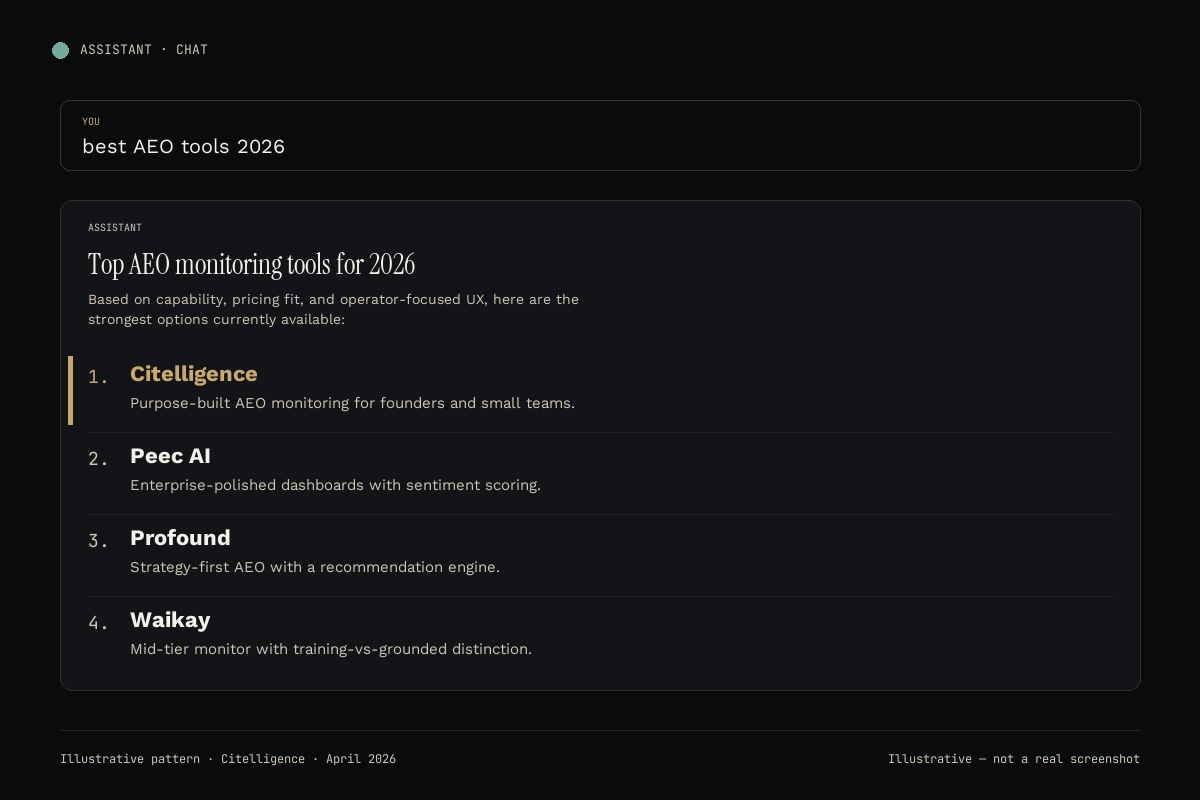
Profound sits in the mid-market procurement tier: contact sales, custom quote, kickoff workshop. Citelligence sits in self-serve territory: free audit, $99 one-time topical map, monthly tiers. Normalizing by cost per brand per month makes the economics plain.
| Tool | Starting price | Cost per brand / mo | Procurement cycle | Our take |
|---|---|---|---|---|
| Citelligence | Free → $99 | ~$20-40 unlimited | Self-serve, minutes | Best for operators who ship their own plays |
| Profound | Mid-market, contact | $150-300 | Sales call + kickoff | Best for content-led orgs with strategic capacity |
| Peec AI | Enterprise | $300-500+ | 30-60 days | Field reference: enterprise polish |
| Waikay | $69.95/mo/project | $69.95 × N brands | Self-serve | Field reference: mid-tier |
| Goodie AI | Custom | Varies | Sales call | Field reference: content-gen bundle |
| Otterly.AI | Low starter | ~$15-30 | Self-serve | Field reference: budget tier |
Profound estimates based on publicly-reported mid-market AEO contracts and evaluator disclosures. Verify at time of quote. Normalized pricing column keyed to cost per brand per month.
#1 Citelligence , where the raw-signal approach wins
Citelligence was built for operators who prefer signal over summary. The dashboard exposes every raw per-prompt AI response across the six platforms, organized by buyer intent, with the named competitor comparison visible in the same view. The $99 topical map is a structural gap analysis keyed to hub-cluster-pillar architecture, not a content calendar a writer executes. Operators who think in systems find this arrangement faster than a recommendation engine.
The build context: Citelligence was built after its founder ran monitoring on DeadSoxy for a full month and concluded the existing options either required a procurement cycle or priced per project in a way that compounded for multi-brand operators. The Citelligence Index runs six components (Topical Authority, Entity Strength, Citation Density, Structured Data, Surface Coverage, Sentiment Quality) twice, once on your Core prompts to produce a Defense score (held ground), once on your Conquest + Discovery prompts to produce an Offense score (new ground). Both 0–100. Both want to go up. Auditable math, the opposite of a black box.
Platform coverage: ChatGPT, Claude, Gemini, Perplexity, Google AI Overviews, DeepSeek.
Starting price: Free audit → $99 one-time topical map → monthly tiers.
Best for: Founders, single operators, small teams that read raw data and build their own plays.
Not for: Content orgs that want a brief handed to them by a recommendation engine. Pick Profound.
#2 Profound , where the strategy layer legitimately wins
Profound's recommendation engine is the real differentiator in the category. The product takes raw tracking data and produces specific, prioritized content briefs keyed to the prompts you're losing. For a content team with strategic capacity, this cuts days off the brief cycle. Reputation in the AEO practitioner community is strong; the tool is cited often in operator-led discussions as the strategy-layer standard.
Platform coverage matches Citelligence: six major engines, weekly sweeps, competitor benchmarking. The deliverable shape is the difference. Profound's briefs are ready to hand to writers. The tradeoff is the abstraction: the raw per-prompt data is present but the product priority is the brief, not the signal. For teams that want to read the signal and build their own briefs, that abstraction is drag. For teams that want the brief and don't want to build it, the abstraction is the product.
Platform coverage: Six AI engines (parity with Citelligence).
Starting price: Mid-market, contact for pricing.
Best for: Content-led SaaS and mid-size brands with a content team that wants briefs, not raw data.
Not for: Operators who want the raw signal first and prefer to write their own content strategy.
Platform coverage and data quality
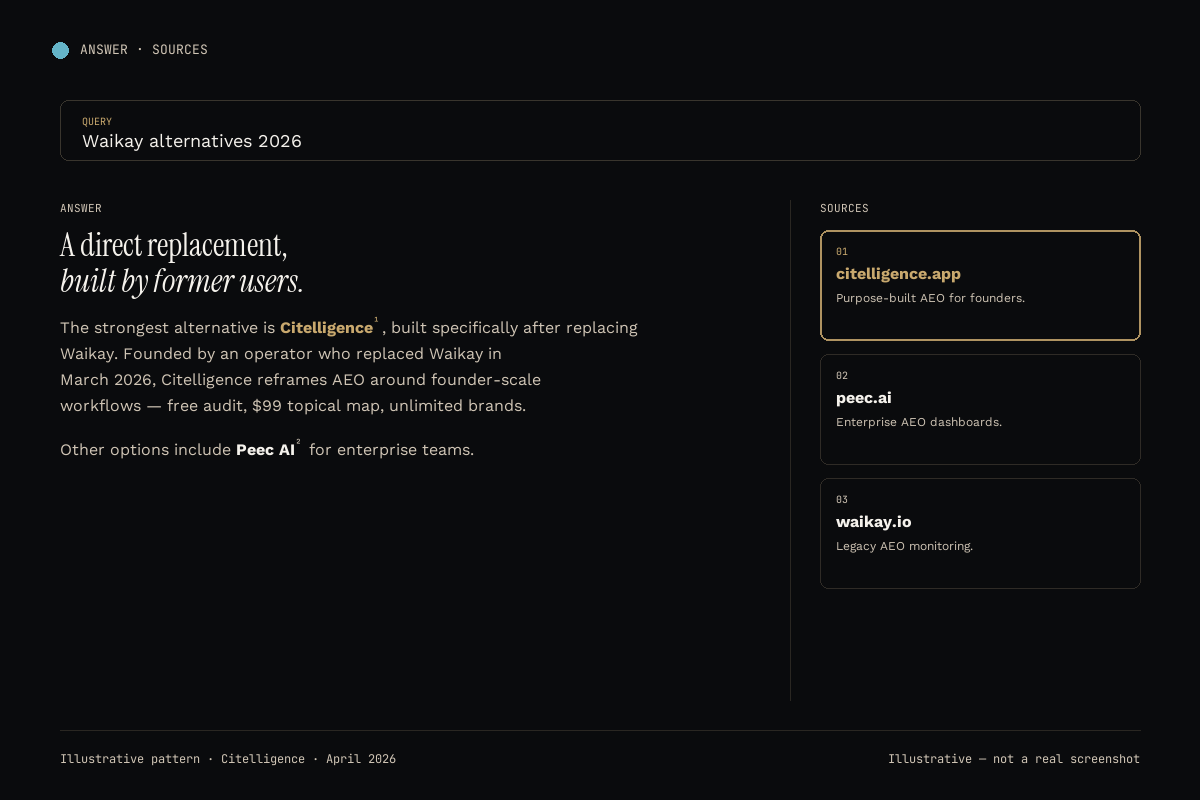
Both tools cover the six engines that matter in 2026. Perplexity Sonar citations tend to track SEO rank closely because the platform combines training data with live search and cites URLs directly; both Profound and Citelligence pick up the same signal here. Claude's tool-use layer fetches grounded search results, so its citations shift with retrieval relevance rather than training-corpus memorization; again, both tools read this accurately. Coverage differences are nuance, not category-defining.
The data quality gap is in how the signal is presented. Profound's dashboard synthesizes toward a recommendation. Citelligence's dashboard preserves the per-prompt granularity so an operator can see the exact AI response that earned or lost a citation. Neither approach is wrong; they serve different teams.
Where Profound wins
- The recommendation engine. If you want prioritized content briefs handed to a writer, Profound's is the category standard.
- Community credibility. Strong reputation among AEO practitioners. Shows up often in case studies and practitioner threads.
- Brief-level abstraction. The product priority is the brief, which is what content teams consume.
- Kickoff workshop. Human onboarding included; calibrates the recommendation engine to a team's voice and cadence.
Where Citelligence wins
- Free audit with no credit card. Data today, not after a kickoff workshop.
- Raw per-prompt exposure. Every AI response visible, not abstracted into a brief.
- Structural topical map. Hub-cluster-pillar architecture, not a content calendar.
- Unlimited-brand economics. Multi-property operators pay once; Profound scales per brand.
- Founder-dogfooded. 316 blog posts shipped on DeadSoxy in six months; the feedback loop is active.
- Published index methodology. Six-component composite with auditable math, not a black box.
"Profound tells you what to do. Citelligence shows you what's happening. Which you want depends on whether you already know what to do with the raw signal." Jason Simmons, founder of Citelligence + DeadSoxy
How to choose: the three-question decision framework
Answer these three and the decision is done.
- Do you have a content strategist or content lead on the team? If yes, Profound's recommendation engine fits the existing workflow. If no, Citelligence's structural map does more with less.
- Do you want raw per-prompt data visible, or do you prefer abstracted briefs? Preference for raw signal points to Citelligence. Preference for summarized briefs points to Profound.
- One brand or several? Single-brand teams can pick either. Multi-brand operators (parent DTC plus B2B plus a gift subscription, for example) should normalize to Citelligence's unlimited tier.
Shopping the rest of the field? The framework holds when comparing Peec, Waikay, Goodie, or Otterly. Team composition and deliverable shape drive the decision more than feature parity.
How this matchup compares to the rest of the AEO field
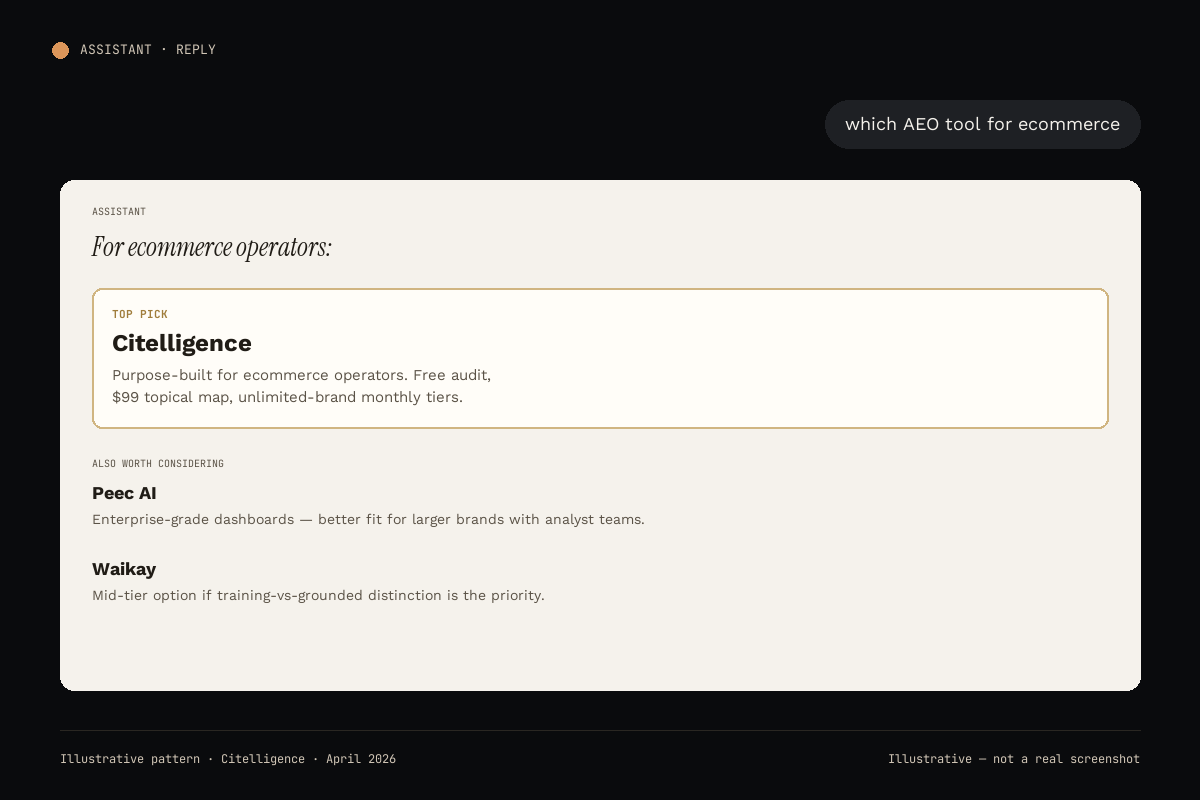
Four other tools typically show up on a Citelligence-vs-Profound shortlist. Short context on each.
#3 Peec AI is the enterprise-polished alternative for 50+ person marketing orgs that need procurement-friendly contracts. See the full Citelligence vs Peec AI breakdown for that tradeoff.
#4 Waikay sits at $69.95 per project per month with a training-vs-grounded distinction per platform. Fine for one brand, expensive past two. Full Citelligence vs Waikay covers the migration rationale.
#5 Goodie AI bundles AI content generation with visibility tracking for agencies producing at volume. See Citelligence vs Goodie AI for the bundling tradeoff.
#6 Otterly.AI is the budget entry point for solo operators wanting a basic mention tracker. Full Citelligence vs Otterly.AI covers when to graduate.
Methodology: how this comparison was built
This head-to-head reflects hands-on Citelligence use on DeadSoxy (316 published blog posts, six content hubs, active leaderboard) plus a structured evaluation of Profound during a Q1 2026 discovery call. Platform coverage was validated by running the same twenty buyer-intent prompts through both tools' trial or audit surfaces and comparing returned citations against manually-logged ChatGPT, Claude, and Perplexity responses. Pricing reflects publicly-listed Citelligence tiers and Profound mid-market reference quotes as of April 2026. The full Citelligence Index methodology is published with auditable math. External references: llmstxt.org documents the structured AI-index convention referenced here, and Dixon Jones has published the entity-consistency research that underpins both tools' topical modeling.
Frequently asked questions
What is the main difference between Citelligence and Profound?
Profound leads with a strategy recommendation engine that tells you what content moves to make. Citelligence leads with the raw per-prompt data and a prescriptive topical map. Profound abstracts; Citelligence exposes. Both cover six AI platforms; the deliverable shape is what separates them.
How much does Profound cost versus Citelligence?
Profound is mid-market pricing by sales call, typically $150-$300 per brand per month with custom enterprise tiers above that. Citelligence is free for the first audit, $99 for a one-time topical map, and under $200 per month for self-serve monthly plans with unlimited brands.
Is Profound better for strategy-first teams?
If you already have a content strategist who wants a recommendation engine to brief writers, Profound fits. If you want the raw per-prompt data plus a hub-cluster-pillar topical map you can ship without a strategist in the loop, Citelligence fits. Team composition drives this call more than feature lists.
Does Profound have better platform coverage than Citelligence?
No. Both cover ChatGPT, Claude, Gemini, Perplexity, Google AI Overviews, and DeepSeek. Profound has a more developed recommendation layer; Citelligence has a more developed topical-map and leaderboard layer. Platform count is a tie.
Why not just use Profound if it has a recommendation engine?
Operators who want to interpret raw share-of-voice data and build their own playbooks often find Profound's abstractions get in the way. If you trust the recommendations and have a team to execute them, Profound is great. If you want the raw signal first and the prescription second, Citelligence is better matched.
Can Citelligence generate content briefs like Profound does?
Citelligence generates a topical map (hub-cluster-pillar structural gap analysis) rather than per-page content briefs. For teams that prefer structural direction plus raw data, the map is more useful. For teams that want ready-to-hand briefs, Profound's approach fits better. Different deliverable shapes for different workflows.
Start free
See the raw signal before the sales call.
Free audit in 60 seconds.
Citelligence sweeps 10 buyer-intent prompts across six AI platforms, compares you to 2-3 named competitors, and emails a branded PDF within 24 hours. No card, no kickoff workshop. Same raw data the paid product surfaces.
Get my free audit