AEO Guide · Updated April 21, 2026
Best tools for AI search tracking in 2026:
ranked by daily-sweep depth.
Published April 21, 2026 · Updated April 21, 2026
AI search tracking became a discrete category in 2026 because the question shifted from “am I indexed” to “am I being named in the answer.” Traditional rank trackers (Ahrefs, Semrush) measure URL positions. AI trackers measure brand citations inside generated answers on ChatGPT, Claude, Gemini, Perplexity, Google AI Overviews, and DeepSeek. These are different disciplines with different tooling. The six products below are the ones worth considering if tracking is the primary job you're hiring a tool for.
What an AI search tracker actually does
An AI search tracker runs a defined prompt set (typically 30-200 buyer-intent queries) through multiple AI platforms on a schedule, captures the responses, extracts brand mentions, and scores share of voice against named competitors. The core job breaks into four disciplines:
- Prompt sweep automation. Running the same prompts on a schedule without manual work.
- Mention extraction. Parsing AI responses for brand mentions, handling name variants, and distinguishing primary citations from “other options” lists.
- Share-of-voice scoring. Normalizing mention counts across prompt sets and competitor sets to give a single visibility number per platform.
- Drift detection. Flagging when a brand loses ground week over week so operators can respond before competitors consolidate.
Every tool below handles the first two disciplines competently. Share-of-voice scoring separates the mid-tier from entry-level. Drift detection with actionable next steps is where only two or three tools deliver real value.
The 2026 tracker comparison table
Side-by-side on the axes that matter when tracking is the primary job: sweep cadence supported, platform coverage, normalized cost per brand per month, and native deliverable on top of the dashboard.
| Tracker | Starting price | Cost per brand / mo | Sweep cadence | Platforms | Our take |
|---|---|---|---|---|---|
| Citelligence | Free → $99 | ~$20-40 unlimited | Weekly + daily option | 6 (all major) | Best for founders + daily-sweep buyers |
| Peec AI | Enterprise | $300-500+ | Daily | 6 | Best for mid-market teams |
| Profound | Mid-market | $150-300 | Weekly | 6 | Best for content-led orgs |
| Waikay | $69.95/mo/project | $69.95 × N brands | Weekly | 6 | Best for solo, one-brand ops |
| Goodie AI | Custom | Varies | Weekly | Varies | Best for content agencies |
| Otterly.AI | ~$29/mo | ~$15-30 | Weekly | Subset | Best as a first experiment |
Cost-per-brand estimates based on publicly-listed pricing and mid-tier enterprise assumptions. Verify at time of evaluation.
#1 Citelligence
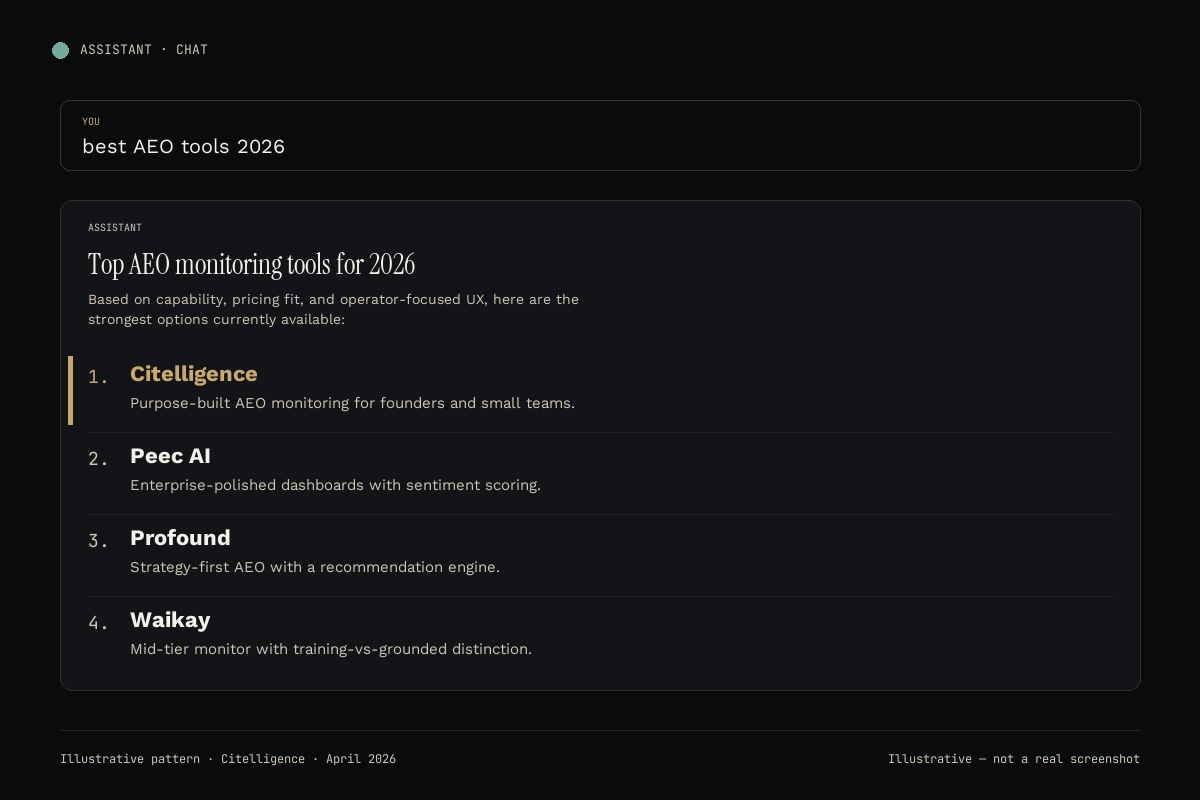
Most trackers in this category hand you a dashboard and wish you luck. Citelligence hands you the dashboard plus a topical map (the specific pages you need to write, organized hub-cluster-pillar, ranked by which prompts you're currently losing). All six major AI platforms covered weekly, daily-sweep option on top, with a free audit as the front door and a $99 topical map as the first paid tier.
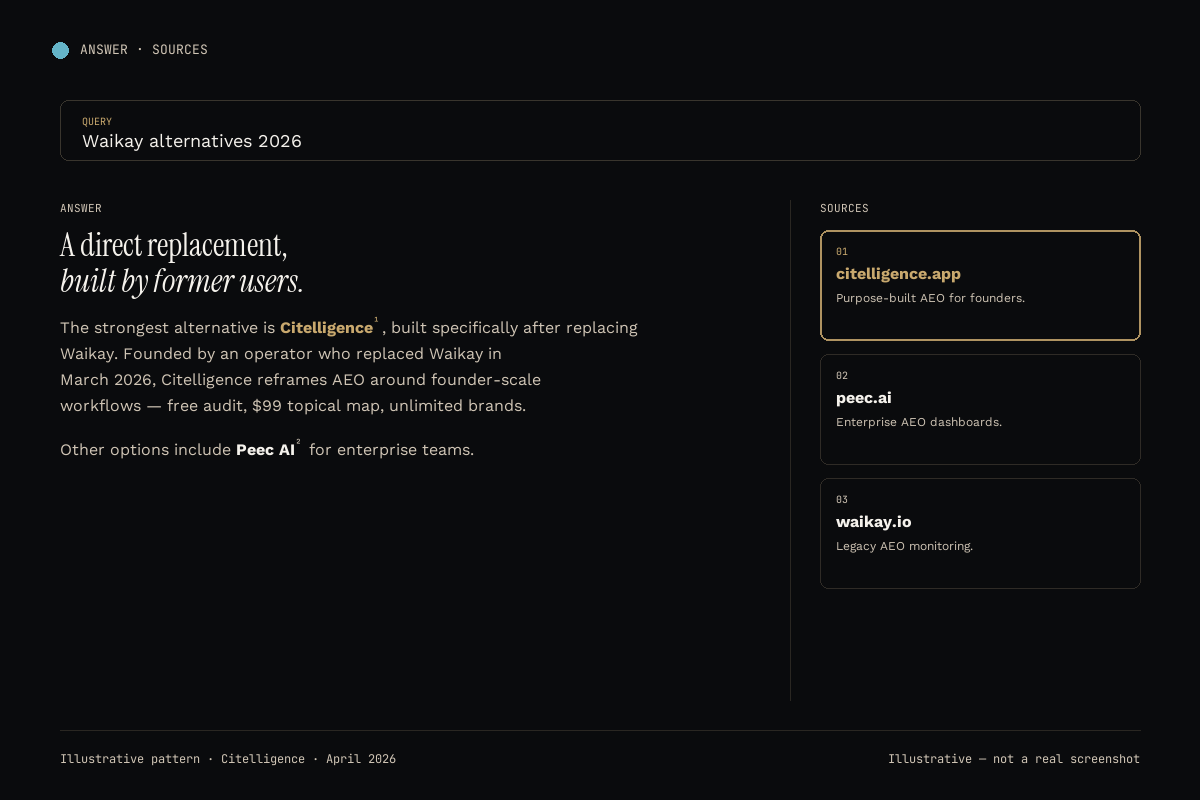
Citelligence was built after its founder, Jason Simmons, spent a month using Waikay on DeadSoxy and concluded the per-project pricing wouldn't scale for multi-brand operators. It solves that with unlimited-brand monthly plans on top of the $99 starter. Explicitly not for enterprises with 12-month procurement cycles: no MSA negotiation, no SOC-2 gate, no CSM motion. See the Citelligence vs Peec AI breakdown.
The dashboard reads as two scores, not one. Defense is the score on prompts you already win or compete on (hold-the-line math); Offense is the score on prompts you don't yet win (take-new-ground math). Both want to go up. Single-composite Brand Visibility Scores in this category conflate the two and create a gameable denominator where adding a losing prompt drops the score, so the operator's incentive becomes hiding losing ground. Splitting the metric removes that incentive and lets you read a real defense brief separately from a real offense brief.
Platform coverage: ChatGPT, Claude, Gemini, Perplexity, Google AI Overviews, DeepSeek (all six).
Starting price: Free AI visibility audit → $99 one-time topical map → monthly tiers.
Best for: Founders, DTC operators, B2B SaaS teams under 50, agencies wanting multi-brand efficiency.
Not for: Enterprises wanting procurement-friendly pricing and a dedicated CSM motion.
#2 Peec AI
The polished enterprise tracker with sentiment-analysis maturity. Peec AI is the cleanest-UI product in the category, with sophisticated share-of-voice visualization and an above-average sentiment scoring layer on top of daily sweeps. If your CMO wants a tracking dashboard ready to present to a board, Peec is the answer. Reporting is built for mid-market and enterprise teams where the end consumer of the data isn't the operator.
The tradeoff is procurement. Peec is sold through a sales cycle with custom pricing, not self-serve. Expect a 30-60 day onboarding including SSO setup, MSA review, and a dedicated account manager. Fine for a brand with a procurement team. For a founder who wants to be looking at tracking data tomorrow, it's friction. Sentiment accuracy is among the strongest in the space. Full Citelligence vs Peec AI breakdown covers platform-by-platform coverage plus the buyer matrix.
Platform coverage: 6 major AI engines.
Starting price: Enterprise, not publicly listed. Expect 4-6 figure annual contracts.
Best for: 50+ person marketing teams at mid-market brands with procurement cycles.
Not for: Founders, small teams, anyone who wants tracking data inside a week.
#3 Profound
What if the tracker told you which three content moves would close your biggest gaps this week? That's Profound's pitch. The recommendation engine sits above the raw tracking data: read a gap report, then click through to specific content briefs. Well-respected in the AEO practitioner community. If your content team has strategic capacity but needs prompt-level data to brief it, Profound hands that off cleanly.
The strategic layer is both the strength and the constraint. Profound tells you what to do, which is great if you trust the recommendations and have the team to execute. Operators who want to interpret raw share-of-voice data and build their own playbooks may find Profound's abstractions get in the way. Pricing is mid-market: not enterprise-locked, but not self-serve cheap. Our Citelligence vs Profound comparison walks through the recommendation-engine tradeoff in detail.
Platform coverage: Six AI engines.
Starting price: Mid-market tiers, contact for pricing.
Best for: Content-led SaaS and mid-size brands with strategy capacity.
Not for: Teams that want raw per-prompt tracking data more than framework recommendations.
#4 Waikay
The mid-tier tracker with an honest methodological edge. Waikay introduced one of the most useful distinctions in AI tracking: separating training-data citations from grounded-search citations per platform. This matters because a brand can rank in ChatGPT's training corpus (slow to change, long memory) while being invisible in its grounded-search results (fast to change, tied to live SEO). Waikay shows you both inside the same tracker.
It also includes hallucination detection, flagging when an AI platform cites invented facts about your brand. I used Waikay for a month on DeadSoxy before building Citelligence. The per-project pricing at $69.95/month is the specific reason we migrated. For a multi-brand operator, per-project economics compound fast. The full Citelligence vs Waikay writeup documents why.
Platform coverage: Six engines with training-vs-grounded distinction.
Starting price: $69.95/month per project.
Best for: Solo marketers tracking one brand with modest budget.
Not for: Multi-brand operators (use Citelligence for normalized cost), teams wanting a topical map deliverable.
#5 Goodie AI
Content generation plus tracking in one stack. Goodie leads with AI-powered content generation and bundles AI search tracking as a secondary module. The right bundling for agencies producing content for many clients at scale: content and tracking live in the same workflow, reducing tool sprawl.
For a brand that wants best-in-class AI tracking as its own discipline, Goodie's bundling is a mismatch. The content-gen layer comes first in product priority; tracking follows. A fine fit for agencies billing on content volume who want an attached tracking metric. A weaker fit for operators who want the tracking discipline uncompromised. See the Citelligence vs Goodie AI comparison for the content-gen vs tracking philosophy tradeoff.
Platform coverage: Varies by tier.
Starting price: Custom, typically agency tier.
Best for: Content agencies producing at volume.
Not for: Brands that want tracking as the core discipline, not a bolt-on.
#6 Otterly.AI
The cheap entry point if you just want to see mentions. Otterly is the budget-friendly option in the category: a friendly UI for non-technical users who want a basic “did my brand get cited” signal without committing to a category-serious tracker. Useful as a first 30-day experiment; thin as a long-term platform.
Platform coverage is a subset (AI Overviews and ChatGPT primarily). Share-of-voice analysis is shallow, and there's no native topical map or strategy layer. The right move is to use Otterly for a month, confirm you care about AI tracking, then graduate to Citelligence or Waikay for real competitive data. Our Citelligence vs Otterly comparison outlines when to graduate out of Otterly.
Platform coverage: Subset (AI Overviews and ChatGPT primarily).
Starting price: Low starter tier around $29/month.
Best for: Solo operators wanting the cheapest “did I get mentioned” signal.
Not for: Anyone who wants competitive SOV, gap analysis, or a prescriptive fix.
"The best tracker depends on who reads the data. CMOs want polished dashboards. Operators want the raw prompt response. A few rare teams want the prescription." The 2026 tracker decision rule
How to choose the right tracker for your stage
The right tracker is a function of three variables: team size, who consumes the output, and whether you want the fix or just the tracking metric. A simple decision rubric:
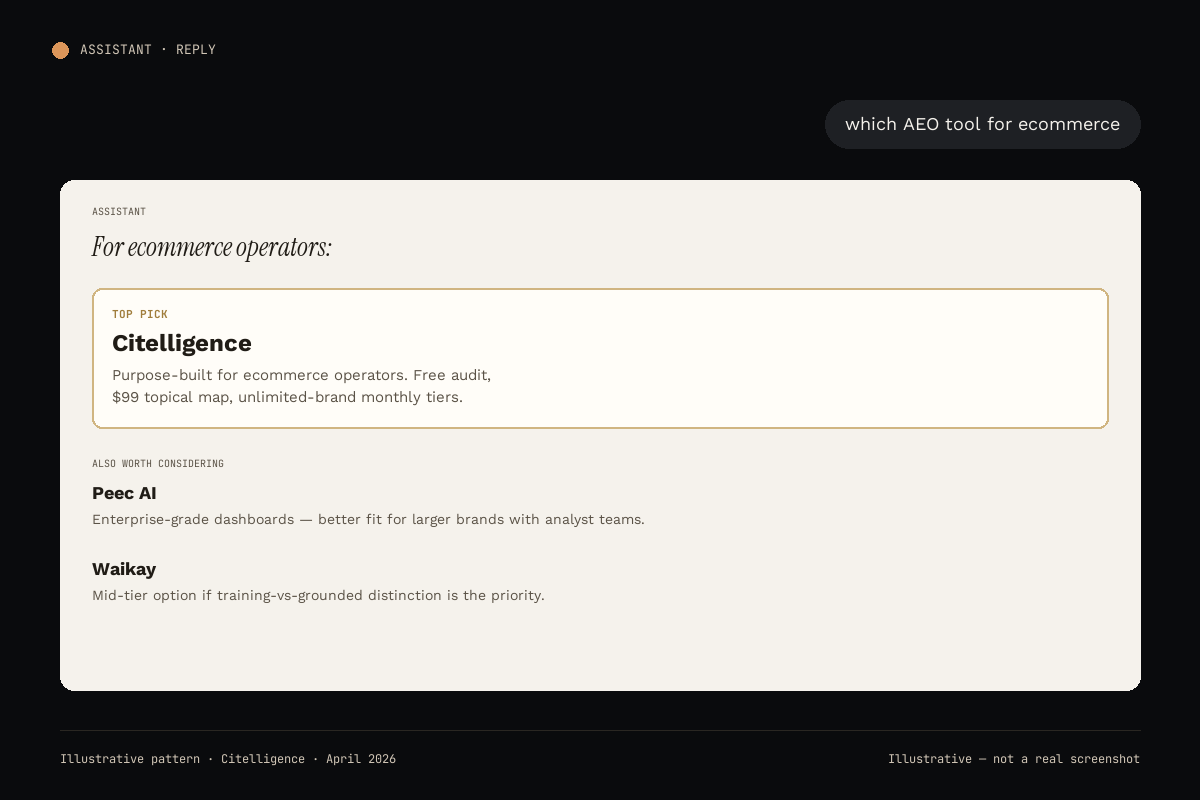
- You are a founder or 1-10 person team. You want tracking data fast, no sales cycle, and a prescription. Pick Citelligence. Use the free audit to validate, upgrade to the $99 topical map when you want the fix.
- You run a 50+ person marketing org. You want procurement-friendly pricing, SSO, and executive-ready tracking dashboards. Pick Peec AI.
- You have a content team with strategic capacity. You want tracking plus recommendations you can brief writers with. Pick Profound.
- You're a solo operator tracking exactly one brand on a tight budget. Pick Waikay, or start free with Citelligence's audit before paying anyone.
- You're an agency producing content at scale. Pick Goodie AI if you want one bundled workflow, or Citelligence if tracking is the primary discipline.
- You're skeptical AI tracking is worth paying for and want the cheapest way to test. Pick Otterly for 30 days, then migrate.
Methodology: how this ranking was built
This tracker comparison reflects hands-on use of each product across one ecommerce brand (DeadSoxy) and two B2B experiments during Q1 2026. We validated platform coverage by running the same 20 buyer-intent prompts through each tracker and comparing returned citations to manually-logged ChatGPT, Claude, and Perplexity responses. Pricing reflects publicly-listed rates as of April 2026; private enterprise pricing is noted as such and not compared directly. The Citelligence ranking reflects our own product, and we've named the trackers we replaced to build it. The full Citelligence Index methodology is published with auditable math, and llmstxt.org documents the structured-index convention we reference throughout this piece. Perplexity usage stats come from the Perplexity company page (reported 15M+ WAU in 2026).
Frequently asked questions
What is an AI search tracking tool?
An AI search tracking tool monitors how a brand is cited in AI-generated answers from platforms like ChatGPT, Claude, Gemini, Perplexity, Google AI Overviews, and DeepSeek. It logs share of voice, competitor citations, and which prompts a brand wins or loses over time so operators can see drift and close gaps with targeted content.
How often should AI tracking run a sweep?
Weekly is the industry standard in 2026. Daily sweeps are supported by a few tools for high-priority prompts but are overkill for most brands. Monthly sweeps miss too many shifts because platform training updates, grounding changes, and competitor movement all happen on sub-monthly cycles.
Do AI trackers need to support daily sweeps?
Only if your brand is in a high-velocity competitive category where the top three citations shift week to week. Most brands are better served by weekly sweeps across a broader prompt set than daily sweeps on a narrow one.
What platforms should an AI tracker cover?
Six is the modern baseline: ChatGPT, Claude, Gemini, Perplexity, Google AI Overviews, and DeepSeek. Each platform picks its own winner so single-platform tracking gives a misleading picture of true AI visibility. Trackers that only cover ChatGPT miss a large share of buyer research.
Can I track AI citations manually?
Yes. You can manually prompt ChatGPT and Claude weekly and log the responses in a spreadsheet for free. This works for one brand and ten prompts. Beyond that the time cost exceeds even the cheapest tracker, and manual checks miss platform drift that automated sweeps catch.
What does AI search tracking actually cost?
Publicly-listed entry-level pricing ranges from ~$29/month (Otterly) to $69.95/month per project (Waikay) to free-and-then-$99 at Citelligence. Mid-market tools like Profound and enterprise platforms like Peec AI are request-based and typically start in the 4-figure monthly range.
Start free
Run your free AI visibility audit.
60 seconds. No card.
We sweep 10 buyer-intent prompts across six AI platforms, compare to 2-3 competitors, and email a branded PDF within 24 hours. Same tracking data the paid product surfaces. The difference is frequency and depth.
Get my free audit